

Every international traveler knows the moment: the immigration counter. You step up with a passport in hand, heart beating a little faster, wondering What will they ask me? For many travelers, especially first‑timers, the uncertainty around immigration questions at airports can cause unnecessary anxiety.
- Immigration Questions at the Airport
- Why Immigration Officers Ask Questions at the Airport
- What Documents Must You Have Ready at Immigration
- Common Immigration Questions You May Encounter
- 1. Purpose of Your Visit
- 2. How Long Will You Stay?
- 3. Where Will You Be Staying?
- 4. Do You Have a Return Ticket?
- 5. Do You Have Sufficient Funds?
- 6. Have You Visited Here Before?
- 7. What Do You Do for a Living?
- 8. Who Are You Visiting?
- How to Answer Immigration Questions With Confidence
- Keep Your Response Simple and Honest
- Look at the Officer (but Be Respectful)
- Don’t Over‑Explain
- Provide Documents Promptly
- What NOT to Say or Do
- What Happens After Immigration Questions
- Regional Context: Different Immigration Scenarios
- How to Prepare Before You Travel
- Advanced Tips for Frequent Travelers
- What Happens If Immigration Asks Unexpected Questions?
- Special Circumstances Travelers
- What Immigration Officers Are Not Looking For
- Technology and Immigration: Automated Options
- Cognitive Preparation: Why Confidence Matters
- Immigration Myths Debunked
- Myth 1: Immigration always asks the same questions
- Myth 2: A smile always helps
- Myth 3: Your phone will always be checked
- Conclusion
- FAQs
Whether you are traveling for tourism, business, study, or visiting family, understanding the common questions asked by immigration officers, how to answer them, and what documents to have ready can transform your journey into a smooth experience rather than a stressful one.
This guide by TripWizard.pk goes beyond generic advice. We’ll walk you through real immigration questions, confident responses, documentation checklists, regional variations (US, UK, Canada, Europe), and best practices, all backed by airline and airport procedures used by professionals every day.
By the end of this article, you’ll know exactly what to expect at the airport immigration counter, how to prepare, and how to answer questions with confidence, no guessing, no panic.
Immigration Questions at the Airport
Most immigration officers ask clear, simple questions to confirm your travel purpose and intent, such as:
- What is the purpose of your visit?
- How long do you plan to stay?
- Where will you be staying?
- Do you have a return ticket?
Prepare honest answers, have your travel documents ready, and be calm. Security officers are trained to assess your travel legitimacy, not to intimidate you.
Why Immigration Officers Ask Questions at the Airport
When you arrive in a foreign country, immigration officers have one legal and safety objective: to ensure that everyone entering the country meets its entry requirements and will abide by local laws during their stay.
The reasons behind asking questions include:
- Confirming your travel purpose
- Verifying your duration of stay
- Ensuring you have proof of onward/return travel
- Checking your financial ability to support your stay
- Verifying accommodation plans
- Ensuring you are not on any security watchlists
This process protects countries from illegal immigration, overstays, fraudulent travel, and potential security threats.
Knowing why questions are asked helps you understand that officers are not there to interrogate you arbitrarily, but to ensure compliance with legal standards.
What Documents Must You Have Ready at Immigration
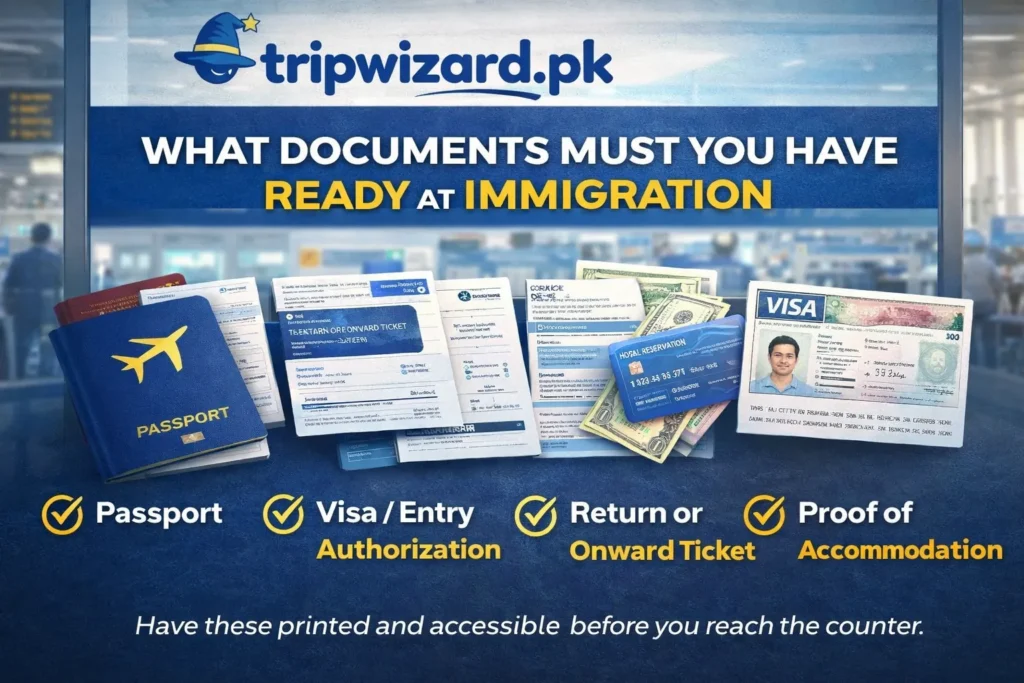
Before you reach the immigration counter, organize the following key documents:
- Passport (valid for at least 6 months beyond intended stay, in most countries)
- Visa / Entry Authorization (if required)
- Return or Onward Ticket
- Hotel Reservations or Proof of Accommodation
- Proof of Funds (bank statement, credit card statement)
- Travel Itinerary
- Acceptance Letter (if student)
- Invitation Letter (if visiting family)
Have these printed and easily accessible. Many travelers make the mistake of having everything packed in a carry-on that is hard to reach or not ready when their turn arrives.
Common Immigration Questions You May Encounter
When you reach the officer’s desk, they will usually start with simple questions before clarifying details. Here are the most frequently asked queries:
1. Purpose of Your Visit
This is the first and most common question. Be direct and truthful.
For example:
- I am here for tourism.
- I am visiting family.
- I am here for a business meeting.
Your purpose should match your visa type.
2. How Long Will You Stay?
Officers ask this to ensure you have a defined itinerary and won’t overstay your visa duration.
Answer confidently with:
- I will be here for X days/weeks.
- My return flight is on [date].
Keep your return ticket visible.
3. Where Will You Be Staying?
Provide the exact hotel or residence address, not vague city names.
Example:
- I will be staying at [Hotel Name] in [City].
- I’m staying with my cousin at [Full Address].
4. Do You Have a Return Ticket?
Officers want to confirm you will leave the country before your visa expires.
Keep your return ticket ready to show.
Good response:
- Yes, I have a return ticket for [date].
- I have a flexible ticket but a confirmed return itinerary.
5. Do You Have Sufficient Funds?
This shows that you can support yourself during the stay.
Officers may ask you to show:
- Bank statement
- Credit card statement
- Cash amount
In some countries, they may scan digital statements.
6. Have You Visited Here Before?
This is to check travel history.
Answer honestly:
- Yes, I visited in [year] for [purpose].
- No, this is my first time.
7. What Do You Do for a Living?
This helps immigration officers understand your ties to your home country.
Example responses:
- I work as a [profession].
- I am a student at [University].
- I run a small business.
8. Who Are You Visiting?
If your visit involves family/friends:
- I am visiting my wife/husband.
- I’m visiting my brother.
Include relationship name and passport or contact info if available.
How to Answer Immigration Questions With Confidence
Answering immigration questions is not about memorization, but about being clear, honest, and calm. Officers are trained to spot nervous behavior that signals uncertainty or dishonesty. Here’s how to answer effectively:
Keep Your Response Simple and Honest
Short, truthful answers work best. Avoid long tangents.
- Good: I am here for tourism, staying 7 days at a hotel.
- Better: Here’s my itinerary and return ticket.
Look at the Officer (but Be Respectful)
Eye contact should be normal, not confrontational.
Don’t Over‑Explain
Answer the question asked and stop. Extra information can confuse or prolong the interview.
Provide Documents Promptly
When asked, hand over the necessary documents in order: passport first, then return ticket, then hotel/visa/financial proof.
What NOT to Say or Do
Some mistakes can raise unnecessary flags:
- Avoid vague answers like for vacation without specifics.
- Never joke about immigration or borders.
- Do not mention dual intentions (e.g., Maybe I will study ).
- Do not offer unsolicited documents; only show when asked.
- Avoid saying I am not sure it signals uncertainty.
What Happens After Immigration Questions
Once the officer is satisfied:
- They will stamp your passport with an entry stamp.
- You may be directed to baggage claim if you haven’t collected luggage already.
- Some airports issue a boarding pass stub with entry/exit info to keep this safe.
- You may walk through customs, where they may or may not check luggage.
No further questioning means your entry was cleared successfully.
Regional Context: Different Immigration Scenarios
Although the core questions are similar globally, immigration practices vary slightly by region.
United States
Immigration officers may ask:
- What city will you visit first?
- Who is sponsoring your trip?
- Can you show proof of funds?
Answer logically and have concise documentation.
United Kingdom
UK officers may ask:
- Do you have evidence of your accommodation?
- What is your return flight schedule?
- How will you support yourself?
Proof and hotel contacts help significantly.
Canada
Canadian immigration is focused on ties to the home country:
- What ties convince us you will return?
- Do you have a job, family, and property?
Strong home ties reassure officers.
Europe (Schengen Countries)
Schengen borders require:
- Travel insurance proof
- Complete itinerary
- Return ticket confirmation
Always match answers to your visa application details.
How to Prepare Before You Travel
Preparation is the secret to sailing through immigration smoothly.
Document Checklist
Keep these in your hand luggage:
- Passport (valid + visa pages)
- Return ticket
- Hotel reservation
- Financial proof
- Travel itinerary
- Family or host contact info
- Travel insurance, if applicable
Practice Your Answers
Mentally rehearse how you’ll answer common questions. This boosts confidence.
Arrive Early and Stay Calm
Rush increases nervousness. Arrive early for your flight and approach immigration patiently.
Dress Appropriately
While not mandatory, neat and respectful attire creates a positive impression.
Advanced Tips for Frequent Travelers
If you travel regularly:
- Apply for trusted traveler programs where available
- Use electronic pre‑clearance options if offered
- Maintain consistent travel history
- Ensure information across visas and entries matches exactly
Repeat histories and consistent documentation reduce extra questioning.
What Happens If Immigration Asks Unexpected Questions?
Sometimes officers ask clarifying questions like:
- Do you have a job offer?
- Are you visiting friends or relatives permanently?
- Why did you choose this travel period?
Stay calm. Clarify politely and connect your response to your itinerary, purpose, and ties to your home country.
Special Circumstances Travelers
Students
You may be asked:
- Which university are you attending?
- How long is your course?
- Do you have proof of enrollment?
Keep acceptance letters handy.
Business Travelers
Be prepared to show:
- Business invitation
- Company letter
- Conference information
Visiting Family
Have:
- Host contact info
- Address proof
- Relationship documentation (if available)
What Immigration Officers Are Not Looking For
Immigration is not an interrogation. Officers are looking to validate:
- Your displayed documents
- Your stated purpose
- Your intent to comply with visa terms
They are not trying to find loopholes; rather, they ensure travel requirements are met.
Technology and Immigration: Automated Options
Many international airports now use automated e-Gates or biometric systems for passport control.
These systems still ask basic questions but minimize human interaction for eligible passport holders.
If you qualify for eGate entry:
- Follow on‑screen prompts
- Insert passport
- Answer yes/no questions
- Proceed when the gate opens
This speeds up entry, especially for frequent travelers.
Cognitive Preparation: Why Confidence Matters
Immigration officers assess confidence as a soft indicator of genuineness.
Clear answers, simple tone, and a straightforward attitude communicate reliability, which is what officers are testing.
Remember: the officer wants you to enter if your travel is valid. They are not there to discourage legitimate visitors.
Immigration Myths Debunked
Myth 1: Immigration always asks the same questions
Truth: Questions vary based on country, travel purpose, and officer discretion.
Myth 2: A smile always helps
Truth: Friendly demeanor is good, but honesty and clarity matter more.
Myth 3: Your phone will always be checked
Truth: Unless there is a specific border security reason, random device checks are rare.
Conclusion
Airport immigration need not be intimidating. Understanding the purpose behind the questions, how to answer logically, and what documentation to prepare are the keys to passing through smoothly. Immigration officers are professionals performing a legal role; they are not there to trap you but to ensure your visit fits the conditions of your visa.
FAQs
What are the most common immigration questions at the airport?
Immigration officers usually ask about your purpose of travel, length of stay, accommodation, return ticket details, and financial proof. These questions help confirm that your entry matches your visa conditions. Clear, concise answers make the process smoother and faster, allowing the officer to complete verification efficiently.
How should I answer immigration questions if I am a tourist?
When asked, clearly state that you are visiting for tourism, mention your planned duration of stay, list your accommodation address, and show your return ticket. A travel itinerary with booked hotels and return dates reassures the officer that you plan a temporary, lawful visit.
What documents should I show at the immigration counter?
Have your passport, visa (if needed), return ticket, hotel reservation, financial proof, and itinerary ready. Keeping these in your hand luggage in an organized folder saves time and reduces stress during questioning. Officers may not ask for all documents, but having them ready enables quick verification.
Will I be asked about money at the airport immigration?
Yes, some countries want to ensure you can financially support your stay. Be prepared to show recent bank statements, proof of funds, or credit card statements. You rarely need large cash amounts, but evidence of financial stability helps.
What if I am visiting family, not staying in a hotel?
If staying with family, provide the host’s address, contact info, and ideally an invitation letter. Explaining your relationship and the reason for your visit minimizes ambiguity. Some countries may ask additional questions to confirm your plans.
Are immigration questions different for work or study visas?
Yes, immigration questions differ based on visa type. For work visas, you may be asked about your job, employer, or contract. For study visas, expect questions about your program, institution, and duration of study. Always align answers with your visa purpose.
Can missing or incorrect documents cause denial?
Yes. Lack of required documentation, incorrect visa type, or inconsistent answers with paper evidence can raise red flags. Double‑check all documents before departure, and ensure your answers accurately reflect your travel purpose.
Will immigration check my phone or social media?
While it is possible in specific security situations, it is uncommon for routine tourism or business entries. Officers may ask general travel questions, but device checks usually happen only if there are security concerns.