

What Are the Main Steps to Perform Umrah?
Umrah consists of four key pillars:
- Ihram: Enter a state of purity and intention.
- Tawaf: Circle the Kaaba seven times.
- Sa’i: Walk between Safa and Marwah seven times.
- Halq/Taqsir: Shave or trim your hair to exit Ihram. This minor pilgrimage can be done anytime, offering immense rewards like forgiveness of sins (as per Hadith in Sahih Bukhari).
Planning an Umrah pilgrimage is one of the most rewarding acts a Muslim can undertake. Unlike Hajj, which is obligatory and time-bound, Umrah is a voluntary act of worship that can be performed year-round, bringing you closer to Allah (SWT) and providing a chance for spiritual renewal. The Prophet Muhammad (PBUH) encouraged it, saying, “Perform Umrah after Umrah, for they remove poverty and sins just as the bellows remove impurities from iron” (Ibn Majah).
Whether you’re a first-time pilgrim from the UK, USA, India, Indonesia, or anywhere else in the world, this guide will walk you through every step with clear instructions, prayers in Arabic (with transliterations and English translations), and practical advice. We’ll cover preparations, common mistakes, variations for women and families, and even how to integrate modern tools like apps for navigation in Makkah.
By the end, you’ll feel confident and prepared. If you’re looking for reliable travel arrangements, platforms like Tripwizard.pk offer global Umrah packages with visa support, flights, and accommodations tailored to international travelers.
What Is Umrah and Why Perform It?

Umrah, often called the “lesser pilgrimage,” is a sacred journey to Makkah involving specific rituals that symbolize devotion and submission to Allah. It’s shorter and less complex than Hajj but holds profound spiritual value.
Umrah is a non-mandatory Islamic pilgrimage to Makkah that can be performed any time of year, unlike Hajj (fard in Dhul-Hijjah). It involves Ihram, Tawaf, Sa’i, and hair trimming, typically taking 3-6 hours to complete the rituals. Benefits include sin forgiveness, spiritual peace, and rewards equivalent to Jihad for some (Tirmidhi). Ideal for global Muslims seeking quick ibaadah visa rules vary by country, but Saudia now offers e-visas for many nationalities.
Historically, Umrah dates back to Prophet Ibrahim (AS) and was practiced by the Prophet (PBUH) multiple times. In today’s world, over 20 million people perform Umrah annually (per Saudi statistics pre-2020), with numbers rising post-pandemic thanks to streamlined processes.
Performing Umrah purifies the soul, strengthens faith, and fosters unity among Muslims from diverse backgrounds. For beginners, it’s a gentle introduction to pilgrimage etiquette.
Preparing for Umrah: Essential Steps Before You Leave
Preparation is key to a smooth Umrah. Start 1-3 months in advance.
To prepare for Umrah, get vaccinated (meningitis, COVID if required), secure a visa (tourist e-visa or Umrah-specific via Nusuk app), book flights/hotels near Haram, pack Ihram clothes, learn rituals, and ensure physical fitness. Budget $1,000-3,000 USD per person globally; apply for permits via official Saudi apps to avoid crowds.
Documents and Visa Requirements
- Visa: Most nationalities can apply for an Umrah visa online through the Nusuk platform (nusuk.sa). It’s free for first-timers in some cases; processing takes 1-10 days.
- Passport and Vaccinations: Valid passport (6+ months), proof of meningitis vaccine, and any required health certificates.
- Permits: Book Tawaf and Sa’i slots via Nusuk to manage crowds.
What to Pack for Umrah
- Essentials: Ihram garments (two white sheets for men, modest abaya for women), unscented soap, comfortable sandals, prayer mat, Quran app on phone.
- Health Items: Medications, sunscreen (Makkah can hit 40°C/104°F), reusable water bottle for Zamzam.
- Tech: Download apps like Nusuk for bookings, Adhan for prayer times, and Google Maps for navigation.
Physical and Spiritual Preparation
Walk daily to build stamina for Tawaf (about 3km total). Memorize key duas. Fast optionally to practice self-control.
A real-world example: A family from Canada shared how practicing Tawaf at home (circling a room) helped their kids stay focused during the actual ritual.
Step 1: Entering Ihram The State of Purity
Ihram marks the start of Umrah, symbolizing equality and detachment from worldly matters.
To enter Ihram for Umrah, perform ghusl, wear Ihram clothes, pray two rak’ahs nafl, make niyyah, and recite Talbiyah at a Miqat (boundary point like Juhfah or Dhul-Hulaifah). Prohibitions include perfume, arguing, and intimacy. This state lasts until Halq/Taqsir.
How to Prepare for Ihram
- Ghusl or Wudu: Cleanse fully (ghusl recommended).
- Clothing: Men wear two unstitched white cloths (izar and rida); women wear regular modest clothes without niqab or gloves.
- Trim Nails and Hair: Remove unwanted hair for purity.
At the Miqat
Miqats vary: Dhul-Hulaifah for those from Madinah, Juhfah for Syrians/Egyptians, etc. If flying into Jeddah, enter Ihram before landing.
Pray two rak’ahs nafl salah (Sunnah), reciting Surah Al-Kafirun in the first rak’ah and Surah Al-Ikhlas in the second.
Making Niyyah (Intention)
Arabic: اللَّهُمَّ إِنِّي نَوَيْتُ الْعُمْرَةَ فَيَسِّرْهَا لِي وَتَقَبَّلْهَا مِنِّي
Transliteration: Allahumma inni nawaitu al-Umrah fa yassirha li wa taqabbalha minni
Translation: O Allah, I intend to perform Umrah; make it easy for me and accept it from me.
Reciting Talbiyah
Recite loudly (men) or softly (women):
Arabic: لَبَّيْكَ اللَّهُمَّ لَبَّيْكَ، لَبَّيْكَ لَا شَرِيكَ لَكَ لَبَّيْكَ، إِنَّ الْحَمْدَ وَالنِّعْمَةَ لَكَ وَالْمُلْكَ لَا شَرِيكَ لَكَ
Transliteration: Labbayk Allahumma labbayk, labbayk la sharika laka labbayk, innal hamda wan ni’mata laka wal mulk, la sharika lak
Translation: Here I am, O Allah, here I am. Here I am, You have no partner, here I am. Verily all praise and blessings are Yours, and all sovereignty, You have no partner.
Continue reciting Talbiyah until reaching the Kaaba.
Tips: If traveling by plane, change into Ihram at the airport or mid-flight. Avoid prohibited acts like using scented products.
Common mistake: Forgetting to remove stitched clothes (men) pack extras.
Step 2: Arriving in Makkah and Entering Masjid al-Haram
Upon arrival, head to the Haram.
Enter Masjid al-Haram with right foot, reciting dua for entry. Gaze at Kaaba, raise hands for dua (accepted time). Proceed to Tawaf. Use gates like Bab As-Salam for ease; apps help locate.
Dua for Entering the Masjid
Arabic: بِسْمِ اللَّهِ وَالصَّلَاةُ وَالسَّلَامُ عَلَىٰ رَسُولِ اللَّهِ، اللَّهُمَّ اغْفِرْ لِي ذُنُوبِي وَافْتَحْ لِي أَبْوَابَ رَحْمَتِكَ
Transliteration: Bismillahi wassalatu wassalamu ala rasulillah, Allahumma ighfir li dhunubi waftah li abwaba rahmatik
Translation: In the name of Allah, and prayers and peace be upon the Messenger of Allah. O Allah, forgive me my sins and open to me the doors of Your mercy.
Upon Seeing the Kaaba
Raise hands and supplicate freely duas are accepted here.
Arabic: اللَّهُمَّ زِدْ هَذَا الْبَيْتَ تَشْرِيفًا وَتَعْظِيمًا وَتَكْرِيمًا وَمَهَابَةً، وَزِدْ مَنْ شَرَّفَهُ وَكَرَّمَهُ مِمَّنْ حَجَّهُ أَوْ اعْتَمَرَهُ تَشْرِيفًا وَتَكْرِيمًا وَتَعْظِيمًا وَبِرًّا
Transliteration: Allahumma zid hadha al-bayta tashrifan wa ta’ziman wa takriman wa mahabatan, wa zid man sharrafahu wa karramahu mimman hajjahu aw i’tamarahu tashrifan wa takriman wa ta’ziman wa birran
Translation: O Allah, increase this House in the honor, respect, and reverence it receives from people. And increase those who honor and respect it—through Hajj or Umrah—in honor, respect, and piety.
A pilgrim from Indonesia recounted how this moment brought tears, reinforcing faith.
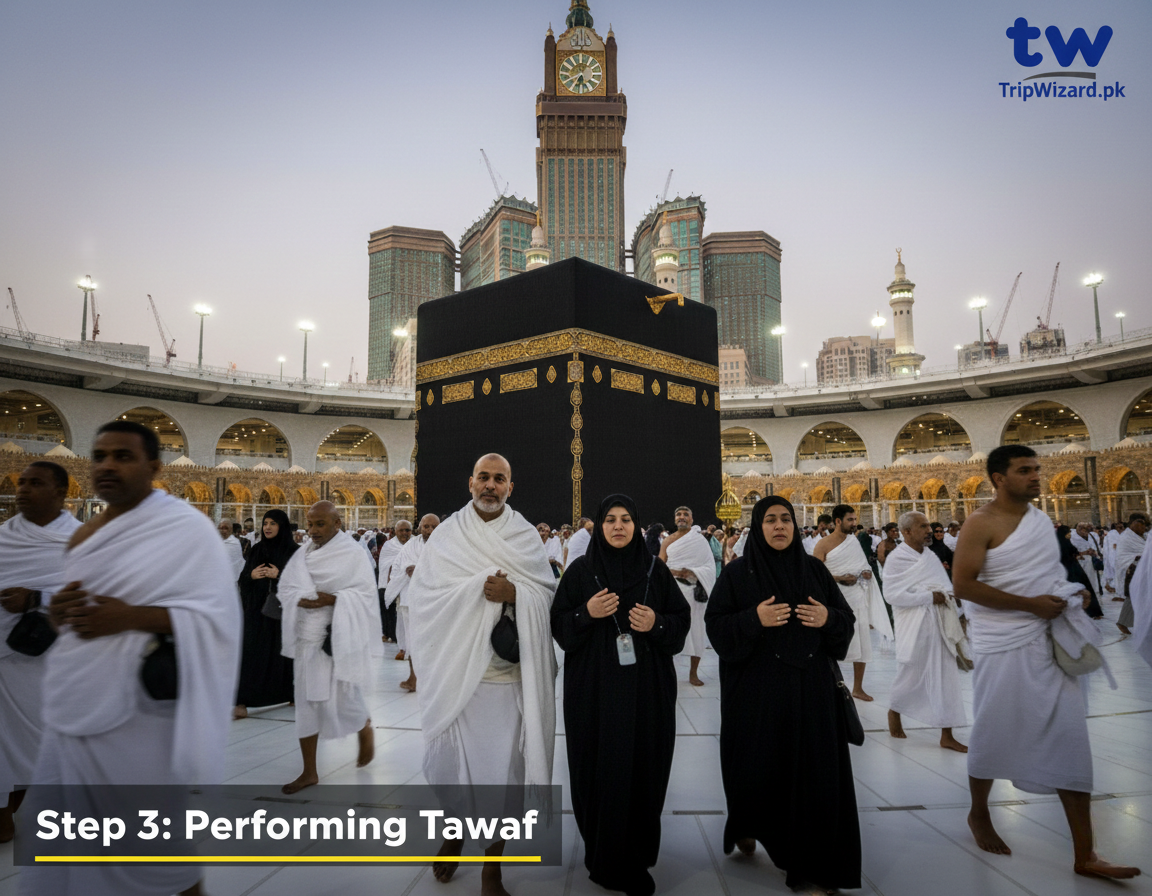
Step 3: Performing Tawaf al-Umrah Circling the Kaaba
Tawaf is the heart of Umrah, seven circuits around the Kaaba.
Start Tawaf from Hajar al-Aswad (Black Stone), circling anti-clockwise seven times. Men uncover right shoulder (Idtiba’) and walk briskly first three rounds (Raml). Recite dhikr/duas; end with two rak’ahs salah. Takes 30-60 minutes; women participate fully but without Raml/Idtiba’.
Preparation for Tawaf

Ensure wudu. Men perform Idtiba’ (right shoulder bare). Start at Black Stone line.
Intention for Tawaf
Arabic: اللَّهُمَّ إِنِّي أُرِيدُ طَوَافَ بَيْتِكَ الْحَرَامِ سَبْعَةَ أَشْوَاطٍ فَيَسِّرْهُ لِي وَتَقَبَّلْهُ مِنِّي
Transliteration: Allahumma inni uridu tawafa baytika al-harami sab’ata ashwatin fa yassirhu li wa taqabbalhu minni
Translation: O Allah, I intend to perform seven circuits of Tawaf of Your Sacred House, so make it easy for me and accept it from me.
At Hajar al-Aswad (Istilam)
Kiss, touch, or gesture toward it, saying:
Arabic: بِسْمِ اللَّهِ وَاللَّهُ أَكْبَرُ
Transliteration: Bismillahi wallahu Akbar
Translation: In the name of Allah, Allah is the Greatest.
Repeat for each circuit.
During Tawaf
Recite any dhikr, Quran, or duas. Between Yemeni Corner and Black Stone:
Arabic: رَبَّنَا آتِنَا فِي الدُّنْيَا حَسَنَةً وَفِي الْآخِرَةِ حَسَنَةً وَقِنَا عَذَابَ النَّارِ
Transliteration: Rabbana atina fid-dunya hasanatan wa fil-akhirati hasanatan wa qina ‘adhaban-nar
Translation: Our Lord, give us in this world what is good and in the Hereafter what is good, and protect us from the punishment of the Fire.
Men do Raml (brisk walk) in first three circuits.
After Tawaf
Pray two rak’ahs behind Maqam Ibrahim, reciting Surah Al-Kafirun and Al-Ikhlas.
Drink Zamzam water, dua:
Arabic: اللَّهُمَّ إِنِّي أَسْأَلُكَ عِلْمًا نَافِعًا وَرِزْقًا وَاسِعًا وَشِفَاءً مِنْ كُلِّ دَاءٍ
Transliteration: Allahumma inni as’aluka ‘ilman nafi’an wa rizqan wasi’an wa shifa’an min kulli da’in
Translation: O Allah, I ask You for beneficial knowledge, abundant provision, and cure from every illness.
- Tips for crowds: Go early morning or late night. Wheelchairs available for elderly.
- Common mistake: Losing count use fingers or apps.
- Variations: Women avoid Raml; children can be carried.
- Mini case: A group from Malaysia used a Tawaf counter app to stay synced.
Step 4: Performing Sa’i Walking Between Safa and Marwah

Sa’i commemorates Hajar’s (AS) search for water.
After Tawaf, walk seven times between Safa and Marwah (starting at Safa, ending at Marwah). Men jog in green zones; recite duas at each hill. About 3.5km total, 45-90 minutes. No Ihram required post-Tawaf, but maintain purity.
Intention for Sa’i
No formal niyyah needed, but intend in heart.
At Safa
Climb slightly, face Kaaba, recite:
Arabic: إِنَّ الصَّفَا وَالْمَرْوَةَ مِنْ شَعَائِرِ اللَّهِ فَمَنْ حَجَّ الْبَيْتَ أَوِ اعْتَمَرَ فَلَا جُنَاحَ عَلَيْهِ أَنْ يَطَّوَّفَ بِهِمَا وَمَنْ تَطَوَّعَ خَيْرًا فَإِنَّ اللَّهَ شَاكِرٌ عَلِيمٌ
Transliteration: Inna as-safa wal-marwata min sha’a’iri Allahi faman hajja al-bayta awi i’tamara fala junaha ‘alayhi an yattawwafa bihima waman tatawwa’a khayran fa-inna Allaha shakirun ‘alim
Translation: Indeed, Safa and Marwah are among the symbols of Allah. Whoever performs Hajj or Umrah there is no blame upon him for walking between them. And whoever volunteers good then indeed, Allah is appreciative and Knowing.
Then Takbir three times and dua:
Arabic: اللَّهُ أَكْبَرُ، اللَّهُ أَكْبَرُ، اللَّهُ أَكْبَرُ. لَا إِلَٰهَ إِلَّا اللَّهُ وَحْدَهُ لَا شَرِيكَ لَهُ، لَهُ الْمُلْكُ وَلَهُ الْحَمْدُ يُحْيِي وَيُمِيتُ وَهُوَ عَلَىٰ كُلِّ شَيْءٍ قَدِيرٌ. لَا إِلَٰهَ إِلَّا اللَّهُ وَحْدَهُ، أَنْجَزَ وَعْدَهُ وَنَصَرَ عَبْدَهُ وَهَزَمَ الْأَحْزَابَ وَحْدَهُ
Transliteration: Allahu Akbar, Allahu Akbar, Allahu Akbar. La ilaha illallahu wahdahu la sharika lahu, lahul-mulku wa lahul-hamdu yuhyi wa yumitu wa huwa ‘ala kulli shay’in qadir. La ilaha illallahu wahdahu, anjaza wa’dahu wa nasara ‘abdahu wa hazama al-ahzaba wahdahu
Translation: Allah is the Greatest (x3). There is no god but Allah alone, without partner. To Him belongs sovereignty and praise; He gives life and death, and He is over all things competent. There is no god but Allah alone; He fulfilled His promise, supported His servant, and defeated the factions alone.
Remember: Repeat at Marwah.
During Sa’i
Walk normally; men jog (harwalah) in green-lit areas. Recite personal duas.
End at Marwah after seventh lap.
- Tips: Hydrate with Zamzam. For families, pushchairs allowed.
- Common mistake: Starting at Marwah invalidate and restart.
- Variations: Women walk at normal pace. Elderly can use electric carts.
A pilgrim from South Africa noted how reflecting on Hajar’s story during Sa’i deepened their patience.
Step 5: Halq or Taqsir Exiting Ihram
The final step releases you from Ihram restrictions.
After Sa’i, men shave heads (Halq, preferred) or trim hair (Taqsir); women trim fingertip-length from hair ends. This completes Umrah now permissible acts resume. Barbers available near Marwah; do it promptly.
No specific dua, but thank Allah.
Tips: Use licensed barbers to avoid infections. Women can trim privately.
Common mistake: Delaying remain in Ihram until done.
Now, enjoy normal activities, perhaps visit Madinah.
Variations and Special Considerations
Umrah for Women
Women enter Ihram in regular clothes, menstruating women can do all except Tawaf (complete later). No Idtiba’ or Raml.
Umrah with Children or Elderly
Children perform as able; infants carried. Elderly use wheelchairs (free in Haram). Family packages via Tripwizard.pk include assistance.
Umrah During Ramadan or Peak Times
Rewards multiplied, but crowds intense. Book slots early via Nusuk.
Umrah from Different Countries
- USA/UK: Direct flights from major hubs; e-visa easy.
- India/Indonesia: Group tours common; check embassy rules.
- Africa/Middle East: Shorter trips; focus on budget airlines.
Global tip: Use currency apps for SAR exchange.
Common Mistakes to Avoid During Umrah
- Breaking Ihram rules (e.g., wearing perfume requires expiation like fasting).
- Invalidating Tawaf by not starting at Black Stone.
- Forgetting wudu during rituals.
- Pushing in crowds practice patience.
- Not booking permits leads to denial.
A first-timer from Australia learned the hard way by not reserving Tawaf, delaying their Umrah.
Benefits and Spiritual Reflections on Umrah
Umrah erases sins, brings peace, and unites the Ummah. Studies show pilgrims report lower stress post-trip (Journal of Religion and Health, 2019).
Reflect daily on intentions.
Tools and Resources for Umrah
- Apps: Nusuk, Muslim Pro, Zamzam.com and zameeninfo.com.
- Books: “A Guide to Hajj and Umrah” by Mufti Yusuf Moosa.
- For rules: Saudi Ministry of Hajj and Umrah for official rules; Islamic Relief for charity ideas.
Frequently Asked Questions About Performing Umrah
Can women perform Umrah during menstruation?
Yes, women can enter Ihram and perform all Umrah rituals except Tawaf and its associated prayer. If menstruation starts before or during Umrah, complete Sa’i and Halq/Taqsir, but delay Tawaf until you are pure. You can stay in Makkah, pray in the hotel, and perform Tawaf later after ghusl. This is the opinion of most scholars, including Hanafi and Shafi’i schools.
What should I do if I unintentionally break an Ihram prohibition?
Minor violations (like using scented soap) require no penalty if unintentional, but it’s best to avoid them. Major violations (such as intimacy) invalidate the Umrah and require expiation usually sacrificing an animal in Makkah. Always repent sincerely and consult a knowledgeable scholar or app like Nusuk for guidance. Prevention through awareness is key.
Is it permissible to perform Umrah on behalf of someone else (e.g., deceased parents)?
Yes, you can perform Umrah on behalf of deceased relatives, elderly parents who cannot travel, or those physically unable. Make the niyyah clearly for them when entering Ihram (e.g., “I intend Umrah on behalf of my mother”). The reward reaches them by Allah’s mercy. Many pilgrims worldwide do this as an act of birr al-walidayn (kindness to parents). Confirm with your madhab for any specific conditions.
How long does Umrah take?
Typically 3-6 hours for rituals, but plan a day with crowds.
Can I perform Umrah multiple times?
Yes, each requires new Ihram.
What if I make a mistake?
Minor errors forgiven; major may need expiation consult scholars.
Is Umrah obligatory?
No, but highly recommended.
How much does Umrah cost globally?
$1,000-5,000 USD, depending on origin and season.
For tailored advice and bookings, visit TripWizard.pk experts in seamless Umrah experiences worldwide. May Allah accept your Umrah and grant you ease.
